
“May Allah Destroy Them!” — The Fall of Córdoba, 1236
“He Placed His Hope in the Lord Jesus Christ” — and Defeated His Enemies

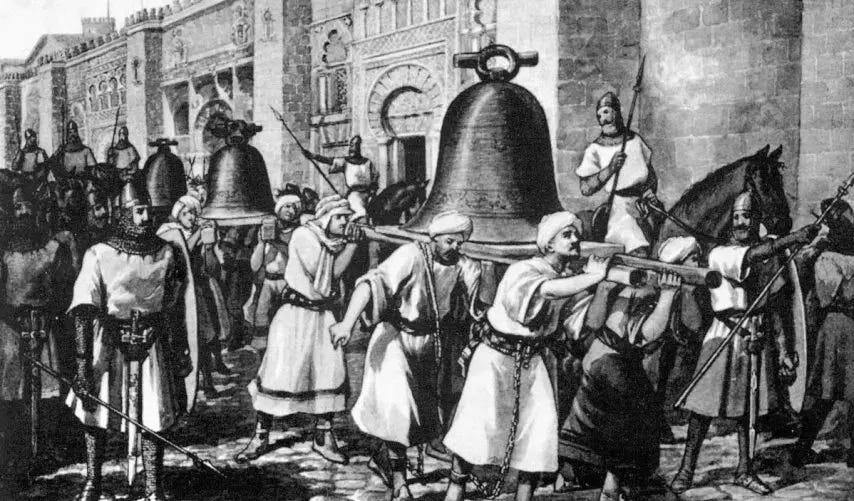
This week in history, Córdoba, which after the eighth century Muslim conquest of Spain had become one of the most important “abodes of Islam,” passed into “the hands of the accursed Christians—may Allah destroy them all!” (to quote from a disgruntled Muslim chronicler).
Six months earlier, in December of 1235, a daring band of Christians, led by a few knights, stormed and took a portion of Córdoba’s eastern quarter. Word reached King Ferdinand III of Castile (aka Saint Ferdinand or Fernando) in January of 1236, even as he was in mourning over the recent death of his 30-year-old wife from childbirth complications.
Through their envoy, the Spaniards “implored him to help them because they were placed in most grave peril.” Against the Muslim “multitude of Córdoba, they were very few” and “separated from the Moors only by a certain wall running almost through the middle of the city.” Though at a standstill, time, the envoy made clear, was not on the Christians’ side.
The king, who for years had been spearheading the Reconquista—the Christian attempt to liberate Spain from Islam—was heavily moved by such a heroic feat; and “the grief for the loss” of his wife “did not long suspend his warlike preparations.” On the same evening that the envoy arrived, Ferdinand’s advisors strongly warned him against setting out immediately, during winter; they cited impassable roads due to snow, rain and floods, and possible ambushes from the “innumerable multitude of people in Córdoba”—to say nothing of Ibn Hud, the de facto king of al-Andalus, who was even then headed to relieve the Muslim city.
But Ferdinand “placed his hope in the Lord Jesus Christ and closed his ears” to all such talk. He was resolved to “aid his vassals who had exposed themselves to such a great danger in his service and for the honor of the Christian faith.” After sending word to his magnates in Castile and León to muster their forces, he set off for Córdoba on the very next morning—with only one hundred knights.
Despite the terrible road conditions, the 35-year-old king rode furiously through rain and sleet and reached the great Moorish city on February 7. Ibn Hud had arrived before him with a much greater force—reportedly thirty thousand infantry and five thousand horsemen—but, instead of awaiting and meeting the Castilians, and perhaps because they had soundly defeated him earlier at the battle of Jerez in 1231, he unexpectedly withdrew back to Seville.
As might be expected, the holed-up Christians, “who were then placed in such great danger in Córdoba,” burst in joy on seeing their king, this man “who had exposed himself to much danger so that he could succor his people!” asserts the chronicler. After rescuing the daring band of Christians, Ferdinand laid Córdoba to siege; as Christian fighters continued to pour in from León, Castile, and Galicia, the noose tightened around the Muslim city.
Five months later, on June 29, 1236, Córdoba—for centuries, “the ornament of the world,” the ancient seat of the Umayyad caliphs and Muslim Spain’s “most stalwart shield and bastion against the Christians”— surrendered to Ferdinand.
Everyone had something to say about this grand event.
Continue reading below…
If you value unflinching, historically grounded analysis that mainstream outlets soften or ignore, consider upgrading. Paid subscribers get:
Several new, full-length articles every week.
Carefully researched pieces you won’t find elsewhere.
Full access to the complete premium archive
Archive of in-depth writing, research, and commentary — all in one place.
Entry into the subscriber chat
A private space for serious readers and thoughtful discussion.
