
Today Rome Died
The true story of the Fall of Constantinople on May 29, 1453—which forever changed Western civilization.
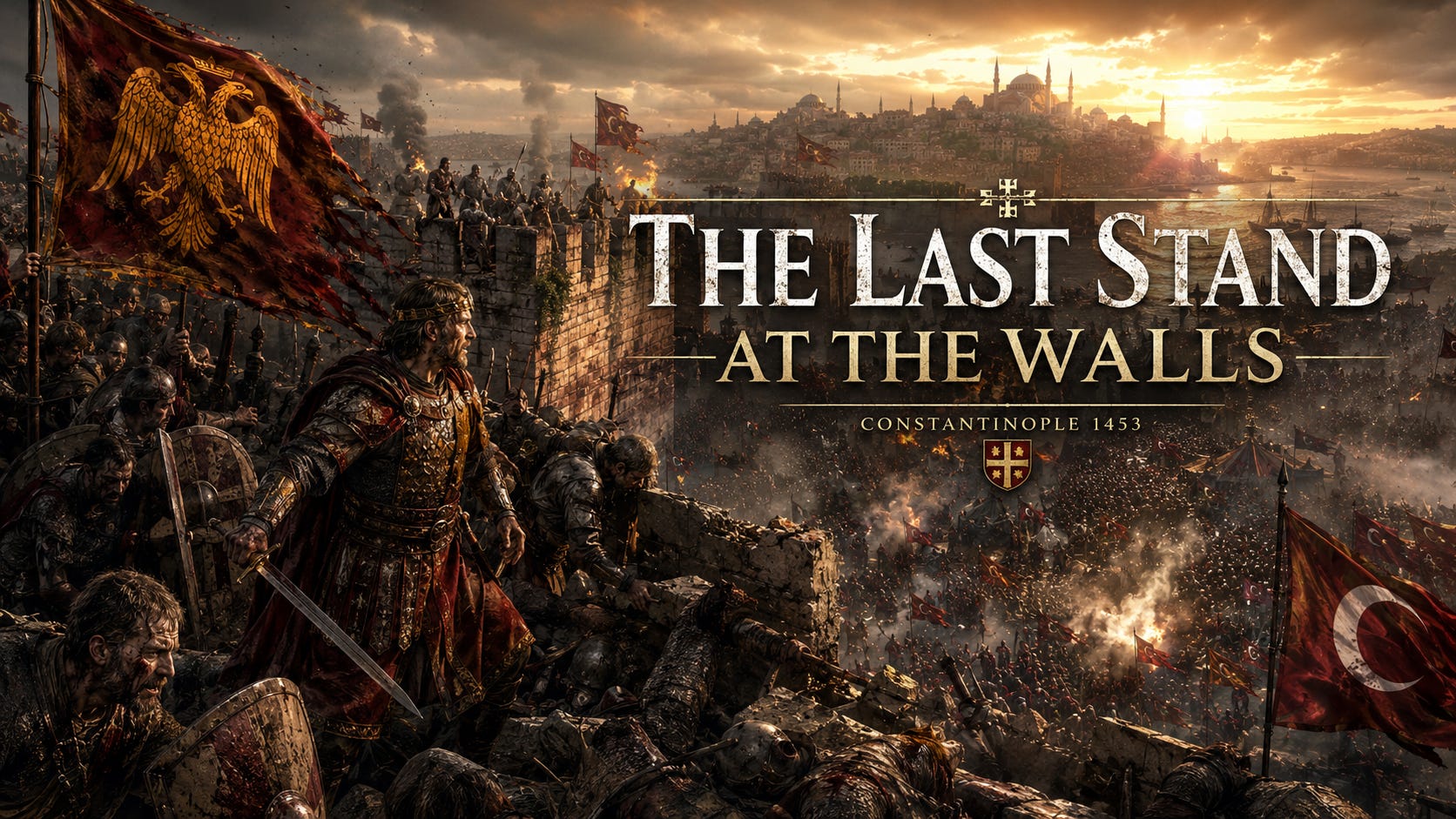
Today in history, on May 29, 1453, the sword of Islam scored one of its greatest victories—the sack of New Rome.
Of all of Islam’s conquests of Christian territory, this was by far the most symbolically significant. For not only was New Rome—more commonly known as Constantinople—a living and direct extension of the old Roman Empire and current capital of the Christian Roman Empire (or “Byzantium”), but its cyclopean walls had prevented Islam from entering Europe through its eastern doorway for the previous seven centuries, beginning with the First Arab Siege of Constantinople (674-678).
When Muslim forces failed again in the Second Arab Siege of Constantinople (717-718), conquering the ancient Christian capital became something of an obsession for a succession of caliphates and sultanates.
However, it was only with the rise of the Ottoman sultanate—so named after its eponymous Turkic founder, Osman (b.1258)—that conquering the city, which was arguably better fortified than any other in the world, became a possibility, not least in thanks to the concomitant spread of gunpowder and cannons from China to Eurasia. By 1400, his descendants had managed to invade and conquer a significant portion of the southern Balkans—thereby isolating and essentially turning Constantinople into a Christian island in an Islamic sea.
Enter Sultan Mehmet, or Muhammad II (r. 1451-1481)—“the mortal enemy of the Christians,” to quote a contemporary prelate. (Note: “Mehmet” is simply an English transliteration of the Turkish pronunciation of “Muhammad.”) On becoming sultan in 1451, Constantinople sent a diplomatic embassy to congratulate him. The 19-year-old responded by telling them what they sought to hear. He “swore by the god of their false prophet, by the prophet whose name he bore,” a bitter Christian contemporary retrospectively wrote, that “he was their friend, and would remain for the whole of his life a friend and ally of the City and its ruler Constantine [XI].”
Although they believed him, Muhammad was taking advantage of “the basest arts of dissimulation and deceit,” wrote Edward Gibbon. “Peace was on his lips while war was in his heart.”
What was in his heart soon became apparent. Throughout the spring of 1453 the city watched helplessly as Ottoman battalion after battalion made its way to and surrounded Constantinople by land and sea. One contemporary remarked that Muhammad’s “army seemed as numberless as grains of sand, spread . . . across the land from shore to shore.” In the end, some one hundred thousand fighters and one hundred warships came.
Few Western Europeans came to Constantinople’s aid. In the end, less than seven thousand fighters, two thousand of whom were foreigners, made ready to protect fifteen miles of walls, while only twenty-six Christian ships patrolled the harbor.
Muhammad commenced bombardment on April 6. Although he tried to go over, through, and under the walls, he made little headway. Some six weeks after he had started bombarding Constantinople, he was no nearer his goal.
At his wit’s end, the sultan held council with his senior officers. Although there was some discussion of withdrawing, in the end, Muhammad decided on vomiting forth every last man he had against the walls in one last-ditch effort.
But first he would need to inflame his men.
So he assembled and exhorted them, in Islamic fashion: “As it happens in all battles, some of you will die, as it is decreed by fate for each man,” he began. “Recall the promises of our Prophet concerning fallen warriors in the Koran: the man who dies in combat shall be transported bodily to Paradise and shall dine with Muhammad in the presence of women, handsome boys, and virgins.”
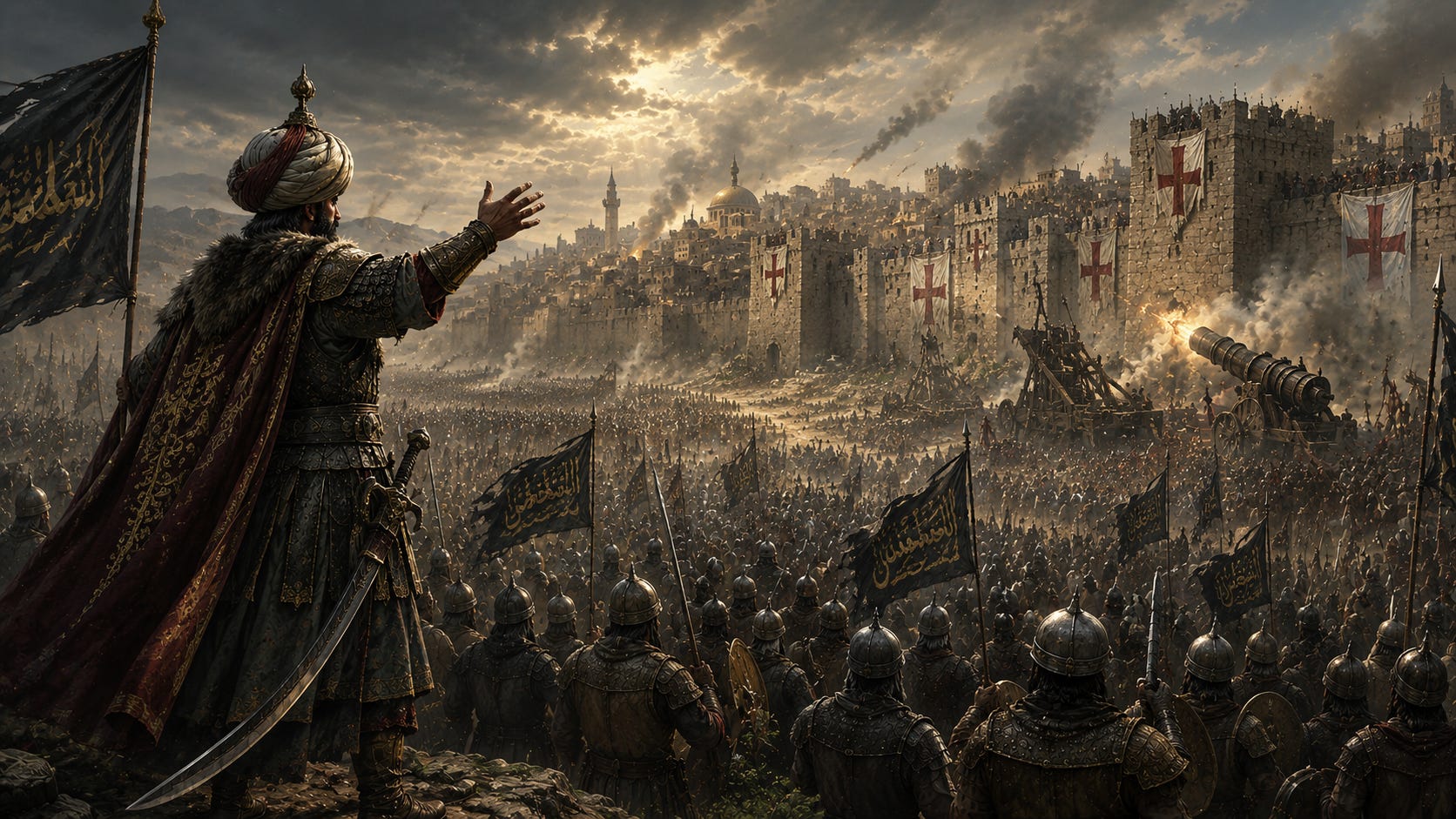
Even so, Sultan Muhammad knew that rewards in the now were always preferable to promises in the hereafter. As Sheikh Akshemsettin had earlier told him, “You well know, that most of the soldiers [particularly the dreaded Janissaries] have in any case been converted [to Islam] by force. The number of those who are ready to sacrifice their lives for the love of Allah is extremely small. On the other hand, if they glimpse the possibility of winning booty they will run towards certain death.”
So the “Sultan swore … that his warriors would be granted the right to sack everything, to take everyone, male or female, and all property or treasure which was in the city; and that under no circumstances would he break his oath,” wrote a Catholic prelate who was present. “He asked nothing for himself, except the buildings and walls of the city; all the rest, the booty and the captives, would be theirs.”
Any Muslim fighter still uninspired by the boons of the here or hereafter was left with a final thought: “[I]f I see any man lurking in the tents and not fighting at the wall,” warned the sultan, “he will not be able to escape a lingering death,” a reference to one of Muhammad’s favorite forms of punishment, impalement (which Vlad the Impaler—“Dracula”—was introduced to while his hostage/guest).
Muhammad’s “announcement was received with great joy,” and from thousands of throats came waves of thundering cries of “Allahu Akbar!” and “There is no god but Allah and Muhammad is his prophet!”
“Oh! If you had heard their voices raised to heaven,” wondered a Christian who was then behind the wall, “you would have been struck dumb with amazement… We … were amazed at such religious fervor, and begged God with copious tears to be well disposed towards us.” All this “most terrible shouting,” relayed another eyewitness, “was heard as far as the coast of Anatolia twelve miles away, and we Christians were very fearful.”
The all-out assault was set for May 29. Atonement, ablutions, prayers, and fasting, “under penalty of death,” were ordered for the Ottoman camp on the previous day. Fanatics of all sorts were set loose to inspire the men to jihad.
Wandering “dervishes visited the tents, to instill the desire of martyrdom, and the assurance of spending an immortal youth amidst the rivers and gardens of paradise, and in the embraces of the black-eyed virgins [the fabled houris],” writes one modern historian.
Criers swept throughout the camp to horn blasts:
Children of Muhammad, be of good heart, for tomorrow we shall have so many Christians in our hands that we will sell them, two slaves for a ducat, and will have such riches that we will all be of gold, and from the beards of the Greeks we will make leads for our dogs, and their families will be our slaves. So be of good heart and be ready to die cheerfully for the love of our [past and present] Muhammad.
Finally, on May 29, around two a.m., Muhammad unleashed all hell against Constantinople.
If you value unflinching, historically grounded analysis that mainstream outlets soften or ignore, consider upgrading. Paid subscribers get:
Several new, full-length articles every week.
Carefully researched pieces you won’t find elsewhere.
Full access to the complete premium archive
Archive of in-depth writing, research, and commentary — all in one place.
Entry into the subscriber chat
A private space for serious readers and thoughtful discussion.
