

If you thought the historical crusades and jihads of which I write are ancient history, think again. Their reverberations echo through history—right down to the present.
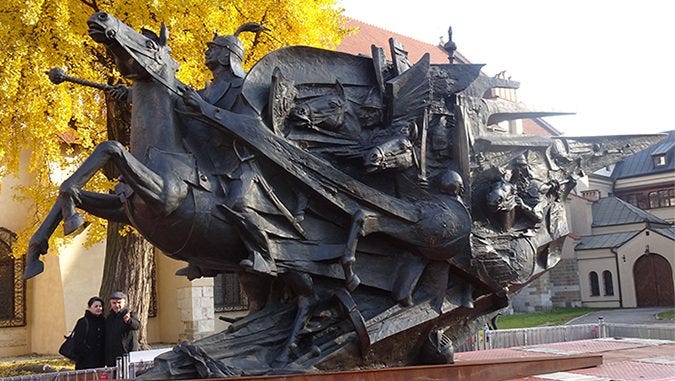
News out of Europe is that Poland is vexed with its Austrian neighbor: Nearly 350 years after he saved Vienna from the Turks in 1683, John III Sobieski, the Polish king and Christian hero, still has no monument in the Austrian capital. This is not because one doesn’t exist—a 26-foot high statue commissioned for the occasion has for years been sitting in storage in Poland—but because Viennese politicians fear that honoring a man who prevented the Muslim conquest of their city might come off as “Islamophobic.”
The Austrian new site, Heute, has the story:
For years, a planned monument to Polish King Jan III Sobieski on the Kahlenberg has been a source of political controversy. Now the debate has flared up again – this time coming directly from the diplomatic sphere. Initial plans for a statue were drawn up as early as 2013; the project was approved in 2018, but later halted. At the end of 2024, just a few months before the Vienna elections in April 2025, City Councilor for Cultural Affairs Veronica Kaup-Hasler (SPÖ) finally gave the monument a definitive rejection … [saying] that Vienna would “not erect a stage that could be instrumentalized for xenophobic incitement as well as Islamophobic or anti- Turkish sentiments.”
Matters have since escalated; the Polish embassy in Vienna has now entered the fray. In an interview published on January 25, 2026, Polish Ambassador Zenon Kosiniak-Kamysz criticized “the city of Vienna” for reneging after it had “promised us the monument,” adding,
Sobieski deserves to be commemorated in Vienna. Without Sobieski, Vienna’s history would have been different. You can’t simply erase his influence… The city of Vienna owes Sobieski something.
Before proceeding, and to appreciate the significance of this ongoing controversy, here’s a brief summary of the Muslim siege of Vienna in 1683—by far one of the most important confrontations between Islam and the West (so much so that I allotted an entire chapter to it in my book, Sword and Scimitar):
In the summer of 1683, some 200,000 Ottoman Muslims invaded Austria — slaughtering over 30,000 Christian captives in the process — and laid siege to Vienna. For over two months, the holed-up and vastly outnumbered Viennese suffered plague, dysentery, starvation, and casualties, especially of women and children.
A quick reminder:
If you’d like to support my work and go deeper than what’s available publicly, consider a paid subscription. For just a few dollars a month, you’ll receive:
New, full-length articles every Week
Carefully researched pieces you won’t find elsewhere.Full access to the entire archive (1,000+ articles)
Two decades of work, all in one place.Entry into the subscriber chat
A private space for serious readers and thoughtful discussion.
Then, on September 12, when the city had reached its final extremity and the Muslims were about to burst through, an anonymous English eyewitness wrote:
After a siege of sixty days, accompanied with a thousand difficulties, sicknesses, want of provisions, and great effusion of blood, after a million of cannon and musquet shot, bombs, and all sorts of fireworks, which has changed the face of the fairest and most flourishing city in the world, disfigured and ruined [it] . . . heaven favorably heard the prayers and tears of a cast down and mournful people.
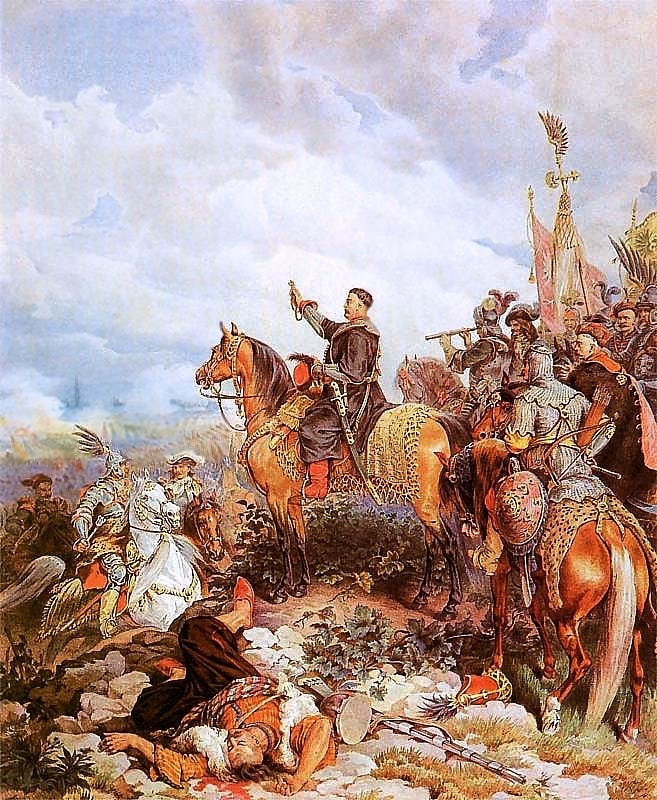
The formidable king of Poland, John Sobieski, had arrived, at the head of 65,000 horsemen burning to avenge and deliver beleaguered Vienna. “It is not a city alone that we have to save, but the whole of Christianity, of which the city of Vienna is the bulwark,” Sobieski had told his men from atop the Kahlenberg hill overlooking the city before leading a thunderous, downhill cavalry charge — history’s largest — against the Muslims and annihilating them.
Hence why for decades many Poles and Austrians—including the Austrian People’s Party (ÖVP)—have been eager to establish a monument to Sobieski on the same hill where his army gathered. Although Vienna had agreed—or in the words of the Polish ambassador “promised”—the city has since refused.
Why? Continue reading..